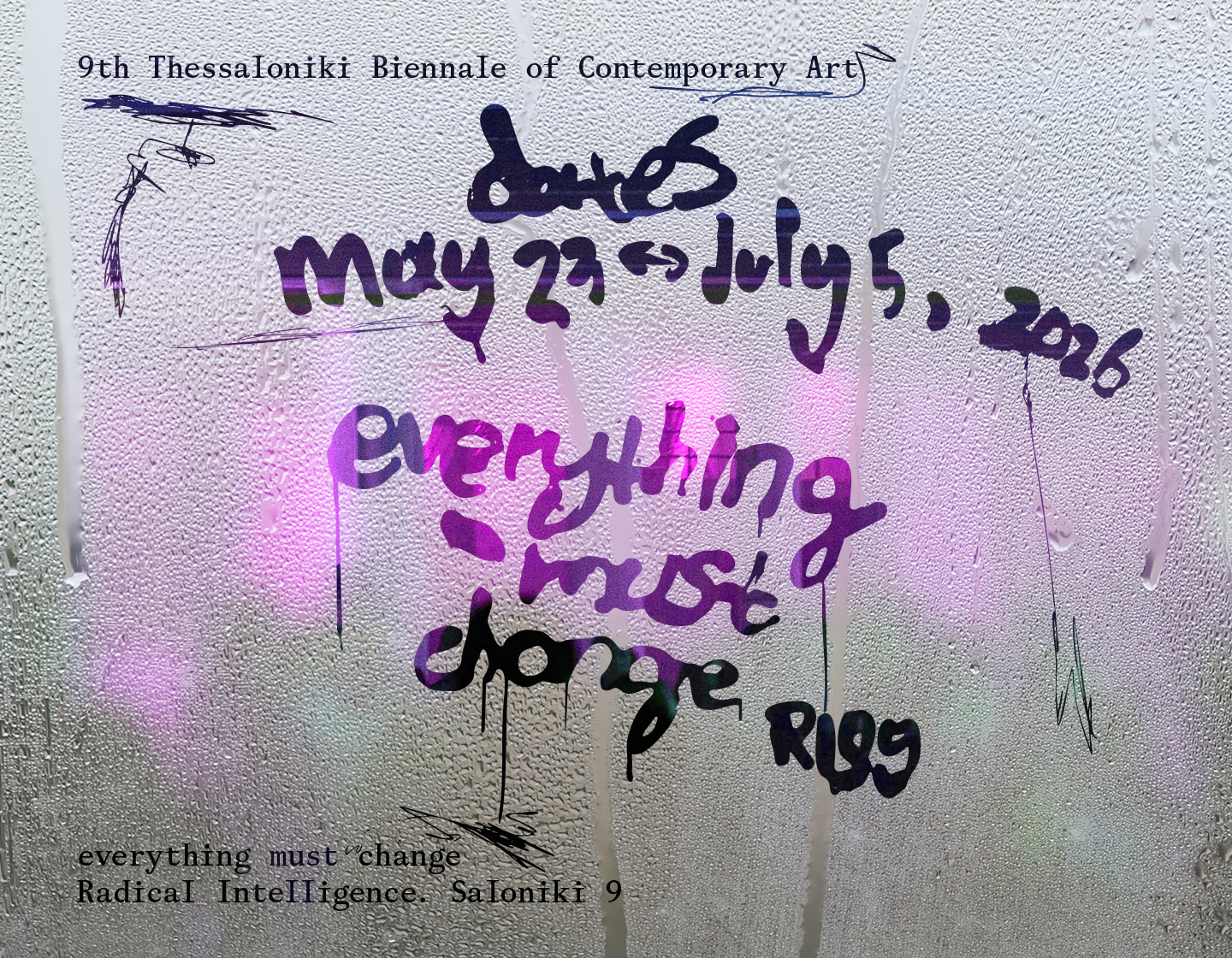
Screenings of the 9th Thessaloniki Biennale of Contemporary Art “everything must change. RIS9”
The 9th Thessaloniki Biennale of Contemporary Art meets the 28th Thessaloniki International Documentary Festival
March 12,13 & 14, 2026, 17.30
Cine MAKEDONIKON
curated by
Nadja Argyropoulou
“Anarchiving change” is the title of the conversation between the 9th Thessaloniki Biennale of Contemporary Art “everything must change. RIS9” and the 28th Thessaloniki International Documentary Festival and its 2026 theme: archives.
Compiled by Nadja Argyropoulou, curator of Biennale 9, this indicative body of short films includes works by Greek and foreign artists to be screened over a three-day period at the movie theater MAKEDONIKON. It is a gesture of anarchiving order, of oblique speculative probing into archives within archives within the boundaries, the economy, of a specified institutional framework such as that of the historic Festival, which is this year delving into the mechanisms of capturing memory.
Following the installation and screening of animation works at the prelude for Biennale 9 (October–November 2025), the works of this upcoming tribute also indicate and integrate the gradually emerging presence and errant movement of Biennale 9 leading up to the implementation of its main exhibition (May 23 – July 5, 2026). Besides, every archive, every collection and selection, is haunted by precisely that which is missing, so that what is happening cannot actually be said, belongs in the realm of disorder, opens up to the possibility of radical transformation.
Biennale 9 is inspired by the method of research and thought, the “critical fabulation” of prominent African-American theorist Saidiya Hartman, as well as by her study of the concept of refusal, of wayward movement as a strategy that disrupts the organizing violence of power and produces an opening towards the possibility of other ways of life, the possibility of inhabiting the world in ways that are radically and collectively just, free, and joyful.
Hartman confronts the archive as a “dead book,” a site of violence, erasure, and silence, animated only in order to record punishment, lynching and terror, the objectification and commodification of Black bodies. She tries, as she notes, to push the documents to their limits and thus retrieve from them what no one dared imagine about what they contain or exclude, to “exhume open rebellion from the case file, to untether waywardness.”
The works featured in the tribute “anarchiving change” detect the openness of such a movement by suggesting different utterances of the social otherwise and the exploration of what might be.
Thursday, March 12 | 17.30
The works Le Sibille and Witchhammer are presented, with a short preface by the curator of the tribute on the representation of witches in art and their persecution in real life, both historically and in the modern context of capitalist accumulation, colonial tradition and punishment of deviant bodies.
In Le Sibille (1977, 30’) by the pioneering trans-feminist collective Le Nemesiache (inspired by the punisher Nemesis), figures embodying manifestations of the prophetess Sibyl, in a séance in the landscapes of Naples, rebel against linear temporality to restore lost or neglected knowledge and to revalidate the subcultures of prophecy. The creative form known as psicofavola, introduced by Le Nemesiache in 1973, served as a vehicle for non-binary, free transformation, while all their performances, prepared through what they called their “poetry workshop” (bottega della poesia), became films in ways that positioned representation within the dynamic field of becoming-in-common, what they described as “creating consciousness through the camera.” Le Nemesiache’s cinema refused the gaze that fixes and excludes, and revealed a world of many worlds through a rebelliously fabulative political imagination that revived lost or marginalized traditions.
The film Witchhammer (1969, 105’) by Ester Krumbachová is a sample of the multidimensional practice of the largely unrecognized Czech creator that concerns Biennale 9 more broadly. In this film, based on a book by Václav Kaplický and borrowing its title from the notorious Malleus Maleficarum (1486), the medieval witch-hunting manual, Krumbachová did the production design, co-wrote the screenplay (with director Otakar Vávra), and composed the lyrics of the revolutionary song “Flandern”. The film revives — drawing an inventive connection with the “show trials” and regime propaganda in 1950s Czechoslovakia — the historical reality of one of the last witch trials in Europe of the Middle Ages. As we read in the archives of Krumbachová, her belief in “free art addressed to free people” is confirmed.
Friday, March 13 | 17.30
The works featured are: A sickness with no cure. Panos Koutrouboussis, Follow Them: Teos Romvos & Chara Pelekanou, and Koursal with a preface and Q&A session with Koursal director Nikos Theodosiou.
These works weave together the itinerant life and memories of creators of the Greek counterculture, who did not establish a protectorate in the margins they inhabited, but generously shared, with a sense of humor, ingenuity and solidarity practices, the restless materials of an aesthetic sociality. In times when symbolic and actual spaces of free thought are vanishing, it is a matter of memory and imagination, a matter of empowerment, to vibrantly (re)visit these stories.
In the film A sickness with no cure. Panos Koutrouboussis (2022, 22’34’’), directors George and Iraklis Mavroidis compile fragments of autobiographical confessions of their friend, subversive painter, writer, and creator of international comics and largely unknown films (such as the cult short From one bouzoukia place to the next) Panos Koutrouboussis.
The documentary Follow Them (2020, 25’) is a wandering visit to the memories, unconventional life and multifaceted work of Teos Romvos and Chara Pelekanou, commissioned by Nadja Argyropoulou to director Evi Kalogiropoulou for the exhibition “Trypa, stories of love, anarchy, care and extinction as told by Teos Romvos & Chara Pelekanou,” at the Plato Contemporary Art Center in Ostrava, Czech Republic.
The film Koursal (2006, 57’) by Nikos Theodosiou deals with the contested modernity of the first floating cinema in 1925 Thessaloniki, a city in social and political turmoil at the time, of the “motley barge” which, after being decommissioned, ended up operating as a floating Naval Cadet School in Palestine, and especially with the people who lived its story.
Saturday, March 14 | 17.30
The works Pacific Club (2022, 17’), Opera Omnia (2025, 10’) and Before She Forgets Heliopolis (2018, 23’) by artist and filmmaker Valentin Noujaïm are presented, in the presence of the artist and with a Q&A session with the curator of the tribute.
Valentin Noujaïm's films blur cinematic categories as a means of drawing attention to what must remain semi-visible or obscure. They summon the sense of occult visions of other worlds only to move complex realities about state, power and remembrance to the intimate terrain of everyday life. In his subtly invoked polemics-poetics, Noujaïm navigates the seas of archives lost and archives regained, in slow cinematic rituals amidst ruins past and ruins future and the haunting totemic presence of an urban commons that can equally crush and support social upheaval.
Caprtions:
Nikos Theodosiou, Koursal (still), 2006.
MORE FROM MOMus