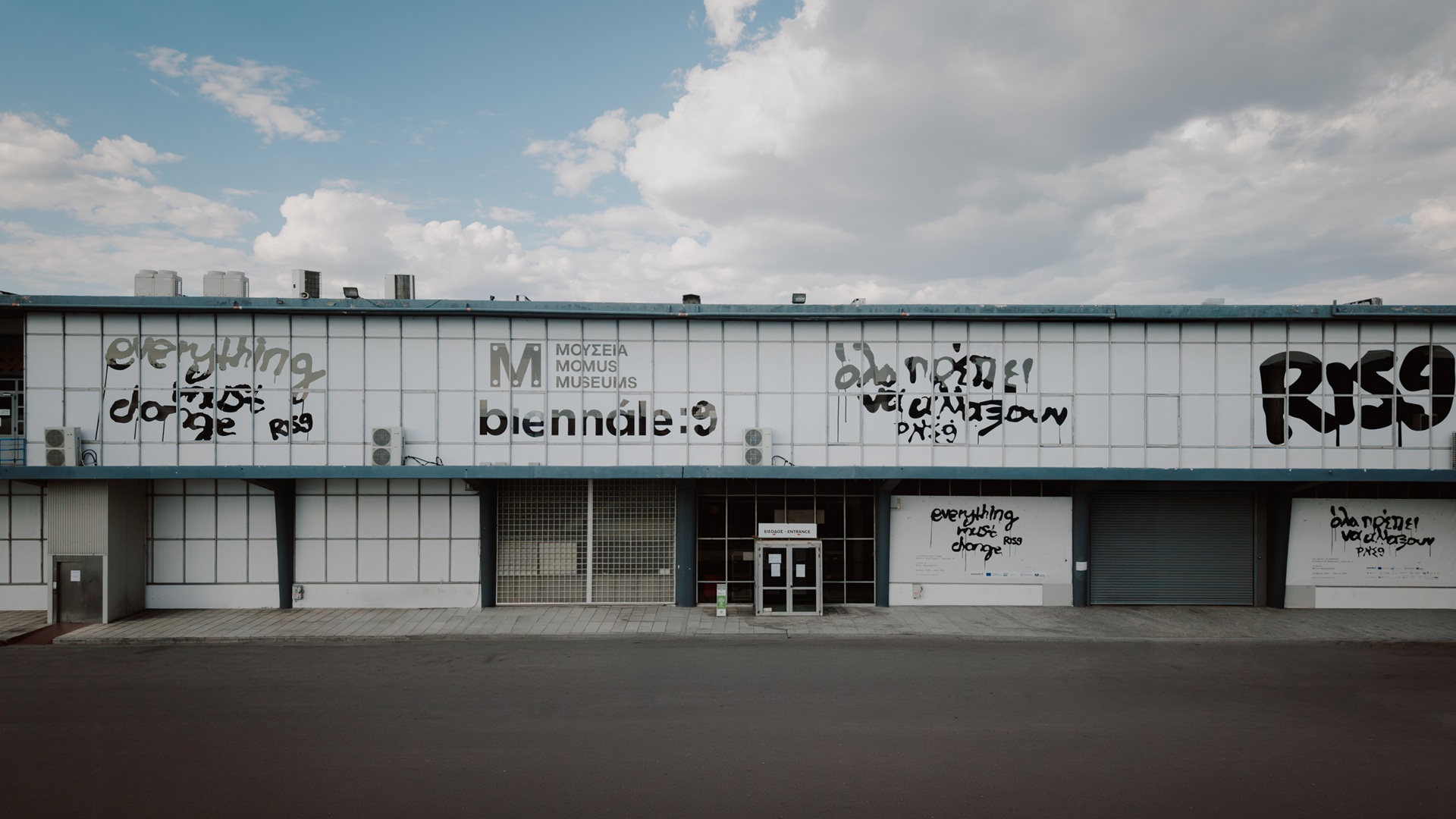
9th Thessaloniki Biennale of Contemporary Art | everything must change. RIS9
May 23 — July 5, 2026
curated by
Nadja Argyropoulou
Organized/implemented by
MOMUS–Metropolitan Organisation of Museums of Visual Arts of Thessaloniki
Venues
– Thessaloniki International Fair – HELEXPO, Pavilions 2 & 3, 154 Egnatia Av., 54636 Thessaloniki
– MOMUS-Museum of Contemporary Art, 154 Egnatia Av., TIF-HELEXPO premises, 54636 Thessaloniki
– Kalochori Lagoon, Axios Delta National Park, 57009 Thessaloniki
Press and professional preview: May 22
Public opening events: May 23–24
Titled “everything must change. Radical Intelligence. Saloniki 9,” curated by independent curator Nadja Argyropoulou and organized by MOMUS, the 9th Thessaloniki Biennale of Contemporary Art is announcing its rationale, artists, participants, and events.
what
Biennale 9 engages with a common(place), yet (re)current, urgent and plural demand, “everything must change.” With its punchiness, it may feel like a revolutionary cry and echo like an empty slogan, ring like rage bait and work like a charm; there is something in it for everyone, and it does not belong to anyone exclusively. It is a phrase that is now, more than ever, wielded by social revolutionaries and technofeudalists alike, by persecuted activists and fascist-adjacent demagogues, by rival social classes and diametrically opposed collective forms of expression, by countercultures and institutional propaganda. It is being used to erase the gap between the home and the streets, the click and the walk, to highjack ambivalence and twist solidarity.
Biennale 9 engages with the incommensurability between our available vocabularies and that which we are asked to describe and live, as well as with art’s ambivalent place, central and marginal at the same time, in a world of violent shifts and widening inequalities. It engages with forms of playful resistance, with fugitive tactics of dismantling and solidarity, with the feedback loop of call and response, or what Arthur Jafa has described as the “quantum dimension of emancipation.”
It is cast as a para-biennale that acknowledges, integrates in its formation paradoxes of enclosure and escape, takes pleasure in errant paths and time warps, and sides with tactics of joyful militancy and the intimate labor of attending to the unrecognized and repressed, the peculiar and the eerie.
If indeed, “in the face of new tyrannies encroaching, we should use art not to ‘ask questions’ but to give audacious answers that nobody asked for” (as per Luce deLire), Βiennale 9 enters by experimenting with an anarchy of answers, refusing the proper and the proposed in outright censorship but also beyond its obvious mandates.
It suggests, through the works, its rationale, and the choice of its venues, a kind of radical intelligence (hence the shorthand “RI”), and sides with a non-fascist AI that does not reproduce forms of dominance but supports autonomy and freedom based on collective activity and suppressed knowledges.
If new solidarities and vocabularies, a “social otherwise,” need to be crafted in order to change life shaped by genocidal capitalism, then Biennale 9 wishes to explore the distance between the utterly improbable and the possible set forth by this need, experiment with the unfolding, metamorphic possibility of this shared refusal-in-solidarity, of the aesthetic sociality emerging as one possible response.
Thus, it chooses to be inspired by Saidiya Hartman on the small scale of Black life, where waywardness is “the avid longing for a world not ruled by master, man or the police . . . the social poesis that sustains the dispossessed . . . a short entry on the possible.”
The shorthand “S9” in Biennale 9’s title evokes a popular, older, eastern in origin, oral name of Thessaloniki (Saloniki), thereby inserting in the Biennale’s utterance a double movement, towards and away from the city, an attempt to foster a sense of togetherness — however temporarily — with Thessaloniki’s obscured, neglected spaces, agents, ghosts, and symbols of life, as well as to traverse the elements that link Assata Shakur’s letter to the Pope with Rimbaud’s poems, Dinos Christianopoulos’s Vardari with Emma Goldman, the critique of fascism as a politics of hate that is written in the language of love, as per Sara Ahmed, with the gallows humor of Beckett and the radicality of Pasolini, a creator that has been honored repeatedly in the north of the Greek south.
Through its shared utterances, visual frequencies and vibrations, terrible mixtures and abundance of f(r)ictions and glitches; through its peripheral and precarious position in the economies of the artworld, Biennale 9 employs a mode of close narration, embracing the stance of the (ins)urgent. It employs the method of critical fabulation and is formed improvisationally by what it proposes and explores.
The essayist of the catalogue of Biennale 9 and interlocutor of its curator, professor T. J. Demos, notes: “Speculative fabulations of emancipatory futurity take shape in the ruins. . . . These are sites of contradiction where the aesthetic becomes situational, tactical — a terrain for struggle. In the convergence of art and politics, the question is not whether resistance is possible, but how it will now be composed, at what cost, to whom. . . . Small steps matter, even when everything must change.”
If, as Gayatri Chakravorty Spivak notes, “the revolution is like housework — you have to do it every day,” then the 9th Biennale of Contemporary Art “everything must change. RIS9” wishes to be part of this every day and, while exploring it, to encompass a proposition for life itself.
how and with whom
Since its prelude in the fall of 2025 about the revolutionary and multifaceted possibilities of science fiction, Biennale 9 is comprised of all kinds of works that explore divergent, or even contradictory stories, ways to speak truth to power; works that suggest when to rant and how to whisper, when to laugh and how to love. The exhibition is primarily taking place in between them, instead of within each individual one, in their visible and invisible connections and collisions.
The exhibition features works by:
Basma al-Sharif, Minos Argyrakis (†1998), Meriem Bennani, Danielle Brathwaite-Shirley, The Callas (Lakis & Aris Ionas), Leonidas Christakis (†2009), Disobedience Archive, Sofia Dona, Errands Group, Stelios Faitakis (†2023), Alexis Fidetzis, Forensic Architecture, Matsi Hatzilazarou (†1987) with Andreas Embirikos (†1975), Pierre Huyghe, Arthur Jafa, Christos Karakolis, Maria Karavela (†2012), Dionisis Kavallieratos, Katerina Komianou, Dimitris Korres, Panos Koutrouboussis (†2019), Maria Kriara, Stefanos Levidis, Ligia Lewis, Le Nemesiache, Eva Papamargariti, Nikos Gravriil Pentzikis (†1993), Agnieszka Polska, Oliver Ressler, Ben Rivers, Kostas Sfikas (†2009), Jakob Steensen, Eleni Tomadaki, Antigoni Tsagkaropoulou, Nanos Valaoritis (†2019), VASKOS (Vassilis Noulas, Kostas Tzimoulis), Marina Velisioti, Lewis Walker, Phillip Warnell & Juri Akiyama, Marie Wilson (†2017), Anna Zemánková (†1986), and an anonymous work [Anon., Zante (?), 18th c., Three-Faced Christ, Loverdos Collection (L 434/CL 429), Byzantine and Christian Museum, Athens].*
The main part of the exhibition also includes the following installations:
Pan Daimonium. surrealism as a state of mind, with works by Samuel Beckett, Victor Brauner, André Breton, Nicolas Calas, Marcel Duchamp, Nikos Engonopoulos, Max Ernst, Wifredo Lam, André Masson, Mario Prassinos, Jean Tinguely, et. al. This section also features the largely unknown art film Daphni (1951, dir. Angelos Prokopiou & George Hoyningen-Huene) and Dimos Theos’s documentary Surrealist Happening (1983) about the movement in Greece.
The Museum of Friendship, with works from the collection of Jean-Marie Drot (1929–2015) as housed in the island of Ios.
Earth in Turmoil and Agitprop machines, with works of the Russian Avant-Garde from the G. Costakis Collection, MOMUS-Museum of Modern Art, Thessaloniki. This section also features the avant-garde animated film Interplanetary Revolution (1924) – the first film that was produced by the animation studio of the State Committee for Technical Cinematography (GosTechKino).
Flipper Zone. Playing against the spectacle, with original publications and reproductions by the Situationist International and Guy Debord, Jacqueline de Jong, Asger Jorn, Ivan Chtcheglov, and works in various media by Nikos Arvanitis, Echelle Inconnue, Experimental Jetset, Forensic Architecture, Marina Gioti (lecture performance), Maria Papanikolaou, Eva Stefani, Hito Steyerl. This section is co-curated by Nadja Argyropoulou and Vanessa Theodoropoulou.
Flights, a series of curated reading spaces within the exhibition, where visitors can read (or listen to) texts, graphic novels, poems, books, archives, verses. Among them, one space is dedicated to poet and author Katerina Gogou (1940–1993) and another to artist Maria-Electra Zoglopitou (1970–1997). There are also Flights curated by the Temporary Academy of Arts (PAT) under the title “ResigNation / A script on the dead,” and by Basma al-Sharif.
Time-based works include:
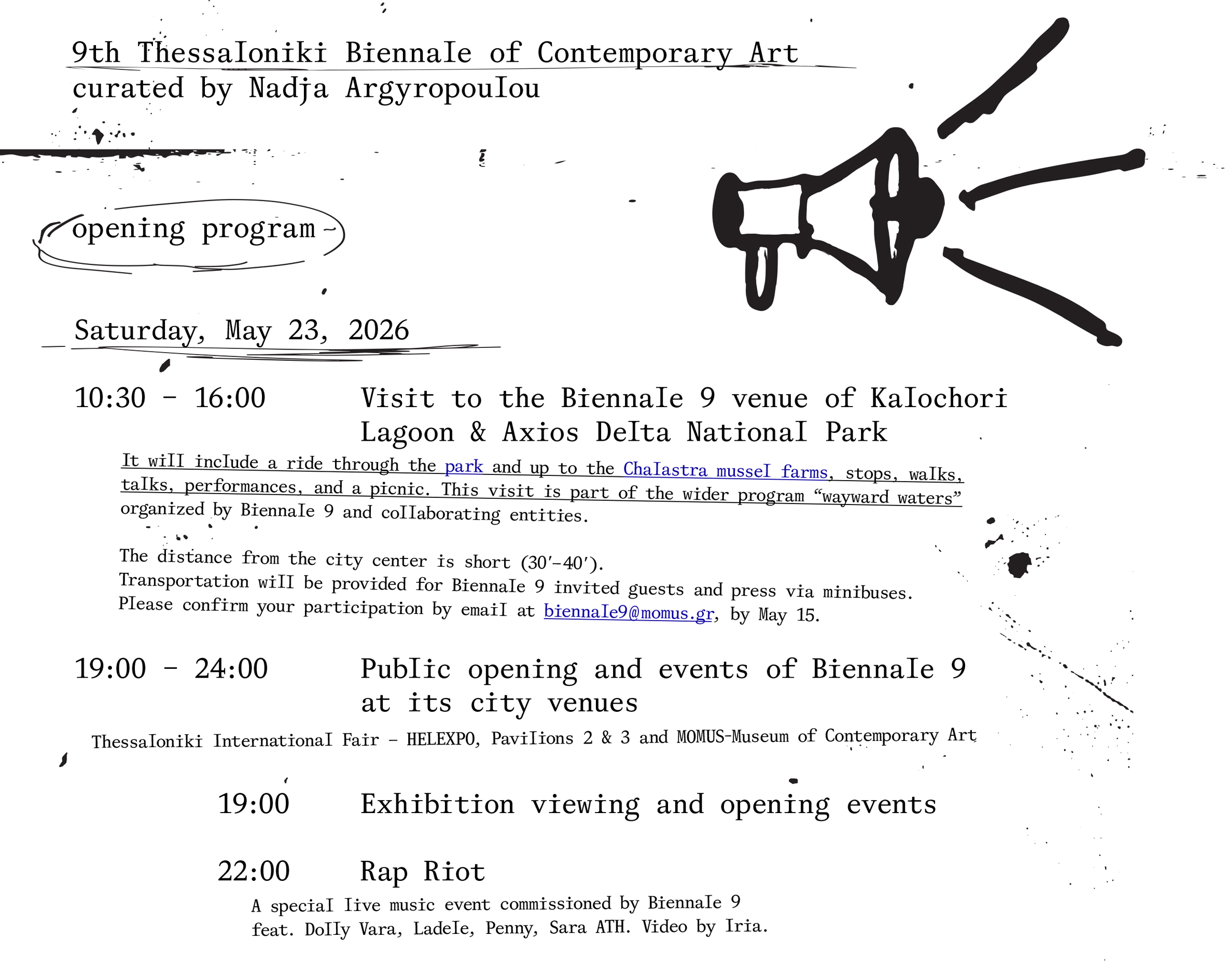
Rap Riot — a music work/event, commissioned by Biennale 9 to performers Ladelle, Dolly Vara, Sara ATH, Penny & Iria (in visuals) for the public opening on May 23 at 10 p.m.
Playing Otherwise — a project conceived by Biennale 9 and realized with Heinrich Böll Foundation - Thessaloniki Office and Another Football, aiming to claim the sport commons and celebrate the revolutionary potential of play. A game of 3-sided football will be realized among self-organized teams FC Abalos, Becazzes FC, Faltsa FC, Muhabeti FC on May 24, at 3:30–5:30 p.m., at the football stadium of Kardia, hosted by the Municipality of Thermi – National Youth Capital 2026.
Wayward Waters — a series of events (performances, lectures, public interventions) that will unfold over the course of the entire Biennale, starting on May 22 with the activation of public water fountains within the wider TIF-HELEXPO area via two performances: The DJ lecture In Overflow by Chara Stergiou and the lecture-performance Tap into it: water is personal by Chris Vrettos and VASKOS. The series is realized in cooperation with Greenpeace Greece and its broader “See you at the fountain” project, TIF-HELEXPO, and several other cultural platforms and civil society entities of Thessaloniki. The program includes a visit to the Biennale 9 venue of Kalochori Lagoon & Axios Delta National Park, a ride up to the Chalastra mussel farms, stops, walks, talks, performances, and interventions by cooperating entities, including iSea, Greek Biotope Wetland Centre (EKBY), and Thermaikos Gulf Protected Areas Management Authority.
Moving in Riot — a program of film screenings that was initiated at the Biennale prelude in October 2025, with collaborations with the Thessaloniki Film Festival and the Greek Film Archive, featuring works by: Cecilia Bengolea, George and Iraklis Mavroidis, Valentin Noujeim, Nikos Theodosiou, Dimos Theos, et al. The program will unfold throughout the duration of Biennale 9, at the MOMUS-Museum of Contemporary Art “Xanthippi Ηoipel” Auditorium, and will be announced progressively. Especially for the three days of the exhibition opening, it will include the following works: Acts and Intermissions by Abigail Child (USA, 2017), BLKNWS: Terms and Conditions by Kahlil Joseph (USA, 2025), The Encampments by Michael T Workman and Kei Pritsker (USA/Palestine, 2025), Herbicidal Warfare in Gaza (2019) and No Traces of Life (2026) by Forensic Architecture, U.F.O. Lost in HEAVEN by Errands Group (Greece, 2025), We Are Making A Film About Mark Fisher by Simon Poulter and Sophie Mellor (UK, 2025), Murdering the Devil by Ester Krumbachová (Czechoslovakia, 1970), and TIF: The Pavilion of the City (Greece, 2026) by Alexandros Litsardakis commissioned by Biennale 9.
In Motion is a program of performances inaugurated with the Aerites Dance Company intervention DETH arthó last October. It included Mephisto Me Studio’s live tagging of used art canvas bags with the Biennale logo, as well as events by the Mamagea Environmental Organization.
Dimitris Ameladiotis is participating in Biennale 9 with his performance the ha(l)lophyte, which will be initially presented at the Axios Delta National Park on May 23, to be repeated later during the Biennale.
The artistic duo VASKOS (Vassilis Noulas & Kostas Tzimoulis) will present their performance From Vardari to Omonoia, with the participation of college students from Thessaloniki (May 22 & 23, TIF-HELEXPO, Pavilion 2, ground floor). The performance is staged with the support of NEON Organization for Culture and Development.
During the opening, the audience will be able to see robotic and human performers in live interaction within the installation In the wild by Antigoni Tsagkaropoulou. Performer: Mochi Georgiou.
The program of enactments and work activations will be continued and enriched throughout the Biennale.
where
The venues that are activated by Biennale 9 co-create a crucial space of (d)rift:
• Buildings within the Thessaloniki International Fair – HELEXPO complex that highlight the site’s ties to modern Greece’s foundational socio-economic narratives and political ceremonies since the 1960s, as well as its current significance as the battleground of competing plans around the function and future of public space. Situated there and hosting part of the Biennale is also the MOMUS-Museum of Contemporary Art, home to the Alexander Iolas collection.
• The unique Kalochori Lagoon on Thessaloniki’s western outskirts, a landscape shaped by immigrant communities, industrial growth, and the gradual emergence of a wetland as a result of land subsidence, groundwater depletion, and the mixing of river and sea waters. Now part of the Axios Delta National Park, the lagoon is rich in rare biodiversity, hosts more-than-human activity, and participates in contradictory narratives of “symbiotic living” as the city inexorably expands to this side too.
You may view/download the material by clicking the hyperlinks.
For the latest information on Biennale 9 participants, events, projects, etc., visit thessalonikibiennale.com
Curator: Nadja Argyropoulou
Visual Identity: studio precarity
Architectural Design: Y2K Architects
Curator’s Assistant: Evelyn Zempou
Lighting Design: Edeko Lighting Studio
Audiovisual Consultant: Makis Faros
Texts Copy-editing & Translation: Fotini Pipi
MOMUS Production Team: Angeliki Charistou, Eftychia Petridou, Silia Fasianou
The Thessaloniki Biennale of Contemporary Arts is co-funded by the European Union (NSRF – “Central Macedonia” Operational Program).
Visiting Hours:
Tuesday through Friday 16:00–22:00
Saturday & Sunday 14:00–22:00
Closed on Monday
Opening Special Visiting Hours:
May 22: 18:30–23:00 | May 23: 19:00–24:00 | May 24: 10:00–22:00

MORE FROM MOMus